Why Wobbling While Putting on Your Shoes is a Common Sign You Need Balance Exercises for Older Adults
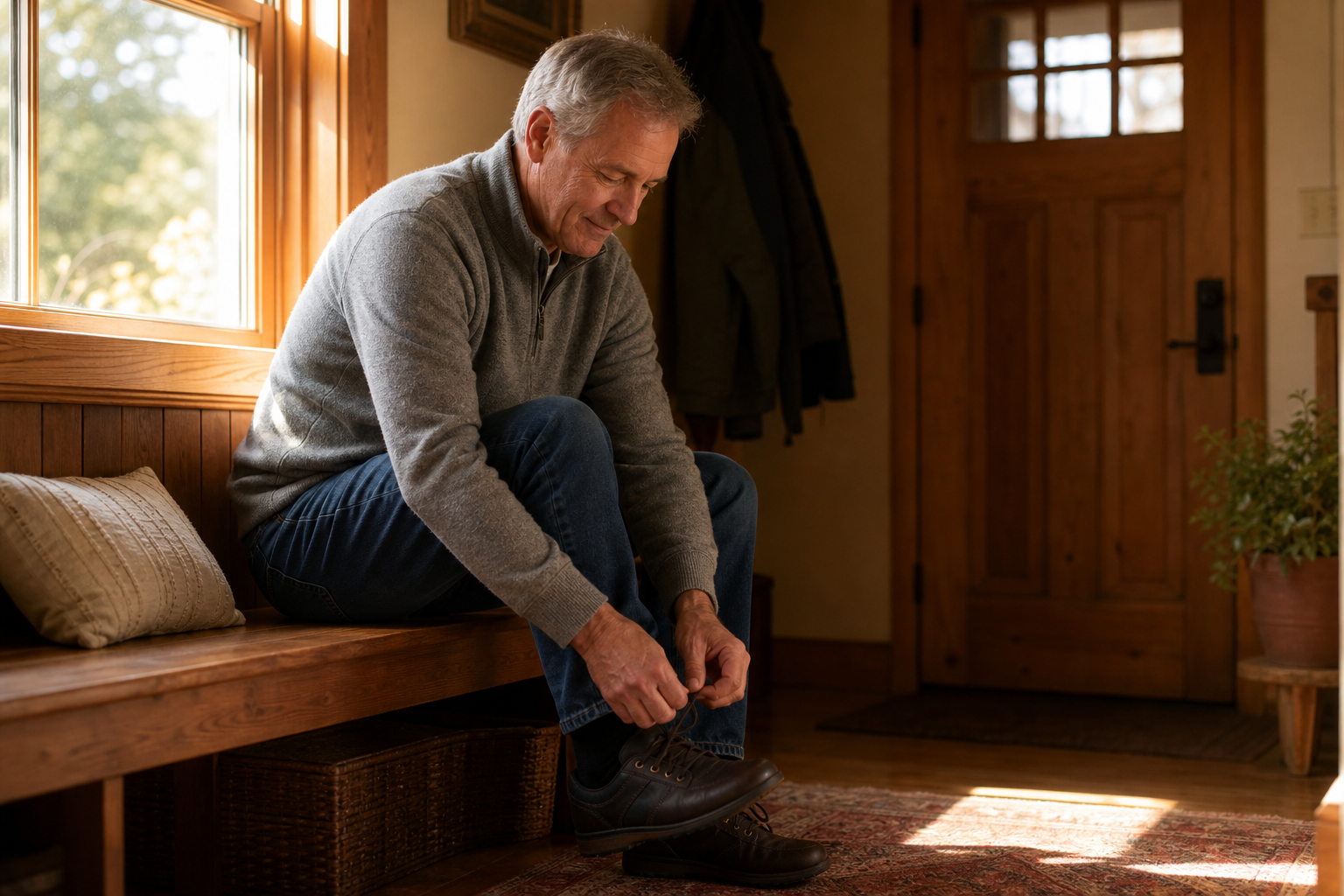
Consider your morning routine. You grab your favorite sneakers, lean over, lift one foot, and suddenly find yourself tilting to the side. Perhaps you have to grab the bedroom wall or sit down quickly to avoid a fall. It is a subtle moment, often dismissed as just being clumsy or tired. However, this simple daily task of putting on shoes is actually a highly sophisticated coordination test. For many people, noticing a slight wobble during this routine is the very first sign that physical stability is shifting. Recognizing these subtle shifts early is key to maintaining independence, and it often highlights the immense value of incorporating safe balance exercises for older adults into your daily routine.
Why Tying Your Shoes is the Ultimate Daily Balance Test
When you stand on one leg to slip on a shoe, your body performs a complex series of micro-adjustments. Your foot shifts weight, your ankle muscles tighten to stabilize your joint, and your brain processes rapid signals about where your body is in space. This is what physical therapists call single-leg balance. In your thirties and forties, these adjustments happen automatically. But as the years pass, muscle mass naturally decreases, joint receptors become slightly less sensitive, and ankle strength can soften. The next time you put on a shoe, notice what you do. Do you easily stand on one foot, or do you find yourself leaning against the closet door? If you must sit down to pull on a boot, it is a clear indicator that your stabilizer muscles are asking for a bit of attention. This is not a cause for alarm, but rather a helpful whisper from your body that it is time to focus on functional stability.
Why Balance Exercises for Older Adults and Seniors Matter Early
Stability is not something that disappears overnight; it is a skill that gently fades if we do not actively use it. Many people only begin thinking about stability after experiencing a slip or a stumble. However, focusing on proactive physical coordination is a cornerstone of fall prevention. By starting simple movements in midlife, you build a physical reserve. Good ankle strength and reactive stability act like an internal shock absorber. If you catch your foot on an uneven sidewalk or trip over a rug, strong stabilizer muscles can help you recover your footing instantly. Beginning these practices early ensures that putting on shoes, stepping over curbs, and climbing stairs remain effortless tasks for decades to come.
Three Balance Exercises for Older Adults to Try at Home
To keep your coordination sharp, you do not need special gym equipment or long, exhausting workouts. You can easily integrate simple habits into your morning or evening routine. Here are three safe, practical movements to try at home.
The Assisted Single-Leg Stance
This movement directly targets single-leg balance. Stand next to a sturdy kitchen counter or the back of a heavy chair. Place one hand on the surface for support. Lift one foot a few inches off the floor, keeping your standing leg slightly soft, not locked. Try to hold this position for ten to fifteen seconds, then switch sides. As your stability improves over several weeks, you might try touching the counter with only one finger, or eventually letting go entirely. If you feel any swaying, simply place your hand back on the counter.
Standing Heel-to-Toe Raises
This habit builds vital ankle strength and calf flexibility. Stand tall with your feet hip-width apart, holding onto a counter for safety. Slowly rise up onto the balls of your feet, hold for a brief second, and then lower your heels back to the floor. Next, gently lift your toes off the ground so you are momentarily balancing on your heels. Repeat this gentle rocking motion ten times. Strengthening the ankle complex helps your feet react quickly when you step on uneven ground.
The Tandem Heel-to-Toe Walk
Imagine walking along a straight line on the floor. Place the heel of one foot directly in front of the toes of your other foot, so they are touching or nearly touching. Take a slow step forward, placing your back heel directly in front of your front toes. Repeat this for five to ten steps. Always perform this walk next to a wall or counter so you can easily reach out if you lose your footing. This movement trains your brain to process narrow support bases, which directly assists in daily safety.
Creating a Safe Home Safety Routine
The secret to improving coordination is consistency rather than intensity. You can turn these physical challenges into a natural part of your day. For instance, you might practice the single-leg stance while brushing your teeth or waiting for your morning coffee to brew. Safety should always come first. Never push yourself to the point of pain or severe instability. If you ever feel dizzy, lightheaded, or experience sharp joint pain, stop the movement immediately. Make sure your practice space is free of clutter, loose rugs, or slippery surfaces. Working near a wall or solid piece of furniture ensures you always have a safety net nearby.
When to Seek Professional Guidance
While gradual changes in stability are a normal part of the aging process, sudden or dramatic shifts require professional attention. If you experience persistent dizziness, feel like the room is spinning, or find yourself falling frequently without explanation, consult a healthcare provider. A doctor or physical therapist can evaluate your inner ear health, check your medications, and design a personalized plan tailored to your physical needs.
References
- National Institute on Aging – Balance Exercises and Older Adults
- Centers for Disease Control and Prevention – Keep on Your Feet Prevention Tips
- Harvard Health Publishing – Improving Your Balance
This blog content is for informational purposes only. For accurate guidance about your personal health, please consult a qualified healthcare professional.
Comments
Post a Comment